25 November 2010

Capital of the Roof of the World


Driving into Lhasa, it doesn’t actually feel very Tibetan.  You have the same large thoroughfares evident in all Chinese cities, industrial estates belching out fumes and producing god-knows-what and huge Chinese slogans printed everywhere.

It was only once we reached the heart of the city, got off the bus and walked the final 100m to our hotel that we could see how it was (and might still have been).  We still had a couple of days of sightseeing ahead of us, which would take us to the Jokhang Temple, the Potala Palace and a couple of other not so well known places in and around the city.


I felt somewhat guilty that we were going into the Potala Palace, as it is essentially the spiritual home of the Dalai Lama, and should theoretically be closed to all but his family and Tibetan government officials.  I think he would feel very unwelcome in its current guise, with all trace of him perfectly cleansed away.  You see his bedroom and study, but no single mention of him.  There are some amazing sights held within though, mainly ornate bejewelled stupas of all the previous Dalai Lamas.

And directly in front of it (standing on a hill all alone, it looks pretty impressive) there is a typically Chinese large square (with  large plaque celebrating the achievement of building it), with a multi-coloured dancing water fountain in it, blaring out classical music mixed with Canto-pop.  We were fascinated by its tackiness. (I have a similar video, but couldn't upload it):


Only an oppressive regime could manage such things.


Where's Wally?  Can you find him?

The local Tibetans spent a lot of time praying in the main square before the Jokhang temple, which dates from the 7th century, and is the holiest place in the country (whoops, slip of the tongue, I meant province).  Some pilgrims have walked for huge distances to be here.  That’s not that unusual in the religious world, but every couple of steps on the way they prostrate themselves.

Just 3,418,882 more to go

The locals were friendly as we made our way around the town (both Han and Tibetan).  We had been warned by a Han in Qingdao that the Tibetans were not good people, and will always try and rip you off, but that’s one of those situations where people have a blinkered view when there is a clash of cultures.  Tibetans probably think similarly of the Han.


Not a good idea
The army presence was immense; I haven’t seen so many soldiers stationed on the streets since Northern Ireland in the 80s.  It’s somewhat menacing, with all of them carrying guns.  No wonder the Tibetans seen rather downtrodden, with that and the constant flux of immigrants from other parts of China.

I also had a sweetcorn flavoured ice-cream, it was awful, and I couldn't finish it.  The local beer was surprisingly decent, simply called Lhasa (I'm still waiting for a beer to be called Swatragh).  Even though it was as light as the usual Chinese beer, the taste was crisp and a little sweet.  The other thing about Chinese beer that I noticed was that it is reasonably drinkable when it'snot chilled.  It still tastes the same (watery).

And finally we had got to a place where men did not use their T-shirts as belly tops (although that was probably more to do with it being a bit nippy).  Ever since Ulan Bataar, we’d seen this constantly, through China, SE Asia and Nepal.

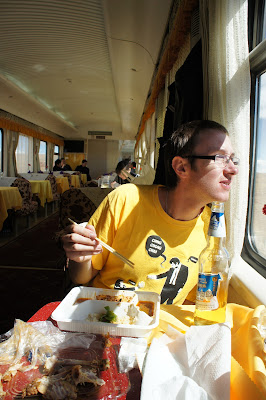
We left on the train at 7:45 in the morning

Bus to Tibet


The bus to the border was bumpy, very bumpy.  The Nepali government has really been getting behind with road works.  Very close to the crossing point, we hit a traffic jam, which necessitated the bus reversing back down a road with a huge drop to one side.  At one point the bus nearly dropped the back wheels of the edge, which had a number of people on the bus clambering to get out, myself included.  It just about stayed on.

After that near brush with death came the ordeal of getting into Tibet.  Those in power in Beijing do not want anything sneaking over the border that might show the Tibetans who the Dalai Lama is.  All guide books need to be discarded before getting to the border.  Rather unhelpfully, none of them tell you that in their actual guide, lest it put you off buying it.  After a bag search (which was not that thorough, I think we could have got our book through), we were in.

We spent the next four days on the bus to get to Tibet going through some of the most stunning landscape yet (you can see we had some dust on our camera sensor and we bother with Photoshop either):


Seen a few monasteries:


How!

And we got to see a bit of everyday life high up in the Himalayas :


It may be cold up there, but there's plenty of sun


It was my first experience of a group tour.  It was a very international group with about 16 different nationalities on board.  A few countries played out to their natural stereotypes, but I’ll not go into details, don't want to offend anyone  J

There were a few problems with people suffering from acute mountain sickness, and one girl eventually got evacuated from Lhasa to Beijing for hospital treatment.  The tour guide dealt shoddily with the situation, but as far as we know, everything turned out ok.

The other problem was the Sinofication of all the Tibetan towns we went to.  Slowly but surely, they are all beginning to look like bland carbon copy Chinese cities.

As much as we like to slag China off for what it is doing in Tibet (and Xinjiang, and anywhere else it calls its own that the locals disagree with), I was grateful for the road, which was so much better than what we had to endure on the Nepali side.  But that is but a small plus to try and counter all the negative things implemented by the central government.

We arrived in Lhasa on the evening of the 13th of October.

20 November 2010

Paragliding in Pokhara

Trying to fly kites unsuccessfully in Nagarkot
The trip back to Kathmandu was a hairy one, more akin to a rollercoaster ride than a scheduled flight.  Audrey spent most of the flight praying to whichever God came to mind.  But it was nothing in comparison (in my opinion) to the 6 hour drive to Pokhara (Audrey was unfazed by this one).

We were heading there to do some paragliding, which I’ve been itching to do for ages.  We had already arranged a driver and vehicle, and convinced Fabio, a bubbly Brazilian, someone we met a few times in the mountains, to join us for the drive.  I was regretting the drive pretty quickly.  It started with a mammoth traffic jam leaving the capital, followed a road which would have even been considered a disgrace in the south of Ireland in the early 80s, combined with a crazy driver who must have felt he had a sixth sense that could see around corners.  This was the main “highway”.

Fabio and Audrey, and a dog's arse

Normally I can cope with dodgy driving, and it’s Audrey who whips out her luggage-case-strap-cum-portable-seatbelt on every bus journey.  On this one though, I was grippping the armrest tightly, and thinking about the cost of flying back.  And I reckon Fabio was wishing he had taken the bus.  Audrey, meanwhile, was calm in the front seat, oblivious to the obvious danger we were in; perhaps her seatbelt giving her a false sense of security.

We arrived safely.

Getting my first cut-throat-razor shave in Pokhara
Pokhara, despite being the third biggest city, was a complete contrast to Kathmandu, laidback and spacious, no in-your-face people trying to sell anything.  There wasn’t much to see either, but I needed a relaxing environment after the drive, hiking and Kathmandu.

Paragliding was good, but not as exhilarating as I expected.  Audrey had been really worried about it, but when we landed I was greeted by an over-excited Audrey.  She had loved it, and my disappointment was mainly due to the fact that my pilot had failed to hit the thermals properly to get up some good height.  Plus, the pace was a bit pedestrian, and I like to be in control, but that wasn’t possible.  Take-off was interesting, running down a hill towards a cliff, but the parachute really picks up the wind well, so we were up in the air before you know it.

Talking to the locals in Nepal was quite easy , as most spoke a good level of English.  We noticed that a lot had been to work in the middle east.  No one had much good to say about being there, which ties in with the recent stories in the news of torture by Saudi families on maids from South Asia and Indonesia.  Most went from Nepal during the Maoist insurgency, when tourism was at a nadir.  But now they have their peace process (which moves just as slowly as the one in Northern Ireland), and little threat from paramilitaries, tourist are returning in droves.

The only positive thing a couple of people could say about Saudi Arabia was that cars obey the traffic lights, which in Kathmandu isn’t really an option, as I only seen one set in the entire country, and that was on the blink, literally simply flashing orange, reminding me of this story of a county in Ireland.

The drive back to Kathmandu was similar as the journey there, but I’d gotten used to it by now, plus the driver was quite good even if he was a bit insane.  We met up with our guide Raj again, and he’d just come back from an audition for the Nepali version of Pop Idol, which I thought was quite funny.  He’d been bursting into song every so often on the mountains, practising I now assume.  He’d managed to get down to the last twenty, but missed the crucial cut for the last 10.  He says he’ll be back again next year.  Good luck to him.

A few more days wandering around the city followed, and we attempted to fly kites we had bought.  We got a quick lesson from one of the locals while we were on the roof of our hotel.  Kite fighting is a popular sport here, where the goal is to cut the string of other peoples kites with yours.  I thought it'd be really difficult for anyone to cut the string, but we predictably lost our kite after a group of experts from a balcony about 50 metres away got their kite string into the path of ours.


After a one night trip to Nagarkot, we headed off to Tibet on a 7 day tour.

18 November 2010

Trekking back down the Khumbu Region


We had a couple of nights in Gokyo, and on the first morning, we were up at 5:30am to hike up to the fourth and fifth lakes (the village is on the shores of the third one).  The weather was still in a state of permanent cloud cover, but we set off optimistically.  The view of Everest from the fifth lake is one of the best in the region.  We don’t have any photos of it though, as it threatened to show through many times, with windows of blue sky opening up every 10-15 minutes, but snapping shut again as soon as Everest was about to be revealed.


Whatever the weather system is around the summit at 8848m, it was hogging the haze that day.  Our guide politely informed us that it was the first time he’d never seen the peak from this point, and after 90 minutes we wandered back down.  20 minutes down the road, from a different angle, the peak (and only the peak) was briefly visible.  It was a bit of a let down.

We arrived back at the lodge tired (Audrey's boots were falling apart  and needed some emergency treatment with superglue), and resolved to be up early again the next day for our assault on Gokyo Ri, a peak of 5357m (about 600m above our current location).  This was the reason we were here, and this is the view that we had been told about.  Fortune (and the sun) shined on us.  The day welcomed us with clear blue skies, and we moved out early.  Rune set a ferocious pace ahead of us, and reached the top in well under two ours.  It took us just over two, but it was hard going.  We had to hand our backpack off to Raj, our guide, as breathing and walking was so difficult.

Getting to the top was a relief, and the view was worth it:


After getting our breath back, we took it all in for an hour and a half, before starting our descent. It was sore on the knees.  Back at the lodge, we had breakfast, and then set off on our descent proper in the early afternoon (leaving poor old Rune all alone).  It was nightfall before we reached our destination, Dole, and hiking without vision is not a good idea.

It was the toughest days hiking we’ve ever done (and are ever likely too).  Started before 6am, finished after 6pm.  Went from 4850m (Gokyo) up to 5350m (Gokyo Ri), then finished down to 4100m (Dole).  My knees did not enjoy that.  Luckily Audrey's boots where holding up at the repair job (anyone need a cobbler?).

During the last couple of days, as we were on the descent, Raj introduced us to a few of the local alcoholic drinks.  We hadn't been drinking anything on the way up, as alcohol and altitude don't mix so well, and you have to give your body the best chance of avoiding altitude sickness.  We had a few headaches from time-to-time, but nothing serious.  The first drink we tried was tongba, which was fermented millet seeds in a jug, that you poured hot water into. The hot water slowly released the alcohol from the seeds, and you could refill about 6 times.  The strength of the drink increased for the first few fills, and then decreased thereafter, until you felt you'd exhausted it (or had enough).  The next day we had a spirit-like drink called 'roxie'.  I've no idea of the correct spelling.  And on the final day came chang, something I would have a few more times in Tibet, and grow to enjoy.


This old guy above is a wonder of human endeavour.  For the last 20 years he's been building better trails for hikers on their way up to see Everest, and he's done this without any government help, based solely on the donations of people passing through.  He lives up in the mountains in self-made rudimentary accommodation, and is 66 years old.  In the donation book, we had a look through, and couldn't believe that someone had donated as little as 6 rupee (about 5p) to the cause (we also couldn't believe that they would actually write that in the book).

We flew out of Lukla on Day 13, as planned.